


The Tribunal
The Tribunal
The Mental Health Review Tribunal is a specialist quasi-judicial body constituted under the Mental Health Act 2007. It has a wide range of powers that enable it to conduct mental health inquiries, make and review orders, and to hear some appeals, about the treatment and care of people with a mental illness.
The Tribunal has a President, two full time and a number of part time Deputy Presidents, a Registrar and approximately one hundred and forty part time Members. Other than for mental health inquiries which are generally conducted by a single legal member of the Tribunal, each Tribunal panel consists of three members: a lawyer who chairs the hearing, a psychiatrist, and another suitably qualified member. All Tribunal members have extensive experience in mental health, and some have personal experience with a mental illness or caring for a person with mental illness. A number of the Deputy Presidents are former Judges and Magistrates.
Transparency
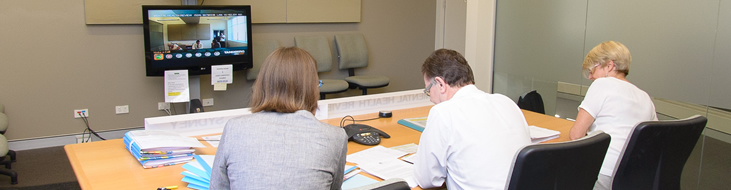
There is a public interest in Tribunal proceedings for a number of reasons, including the power it can exercise in people’s lives and the safety of the patient and members of the public. For these reasons, the Tribunal proceedings are open to the public. A number of panels sit daily at our building in Gladesville to conduct hearings, sometimes by video or telephone. Others sit in hospitals, community health centres, secure and medium secure facilities around the State. Gladesville is readily accessible but it is recommended to contact the Tribunal first in case sittings have changed. Sittings in secure and medium secure facilities are less accessible and arrangements would have to be made in advance.
The Tribunal may sometimes order that proceedings be conducted wholly or partly in private. Such an application would normally be made and determined at the start of the hearing. The law prohibits publishing the names of patients, witnesses and persons mentioned in proceedings. While you may sit in and listen to a hearing as a member of the public, you cannot not identify people involved in the proceedings afterwards.
Jurisdiction
The Tribunal has a wide jurisdiction, and conducts both civil and forensic hearings.
In civil hearings, the Tribunal may:
- conduct mental health inquiries and make Involuntary Patient Orders authorising the continued involuntary detention of a person in a mental health facility;
- review involuntary patients in mental health facilities, usually every three or six months, and in appropriate cases every twelve months;
- review voluntary patients in mental health facilities, usually every twelve months;
- hear appeals against an authorised medical officer’s refusal to discharge an involuntary patient;
- make, vary and revoke Community Treatment Orders;
- hear appeals against a Magistrate’s decision to make a community treatment order;
- approve the use of ECT for involuntary patients;
- determine if voluntary patients have consented to ECT;
- approve surgery on a patient detained in a mental health facility;
- approve special medical treatment (sterilisation); and
- make and revoke orders under the NSW Trustee and Guardian Act 2009 for a person’s financial affairs to be managed by the NSW Trustee.
In the forensic division, the Tribunal:
- reviews those found unfit to be tried and referred to the Tribunal by aCourt;
- reviews the cases of forensic patients found to have committed a criminal act, but been found not criminally responsible by reason of a mental health or cognitive impairment;
- reviews the cases of forensic patients that have received a "limiting term";
- reviews those who have been transferred from prison to hospital because of a mental illness (correctional patient); and
- makes, reviews, varies and revokes Forensic Community Treatment Orders.
The Tribunal’s decisions can involve the consideration of quite complex issues, and can impact directly on people’s lives, health and liberty. In making its decisions, the Tribunal seeks to balance what are often competing rights - the individual’s right to liberty and safety and to freedom from unnecessary intervention, the individual’s right to treatment, protection and care, and the right of the community to safety and protection. Given the importance of these decisions, it is essential that the Tribunal receives the very best evidence available when hearing applications and making its decisions.
Objects and Principles
The Tribunal actively seeks to pursue the Objects of the Mental Health Act 2007 (s3). These are:
- to provide for the care and treatment of, and to promote the recovery of, persons who are mentally ill or mentally disordered, and
- to facilitate the care and treatment of those persons through community care facilities, and
- to facilitate the provision of hospital care for those persons on a voluntary basis where appropriate and, in a limited number of situations, on an involuntary basis, and
- while protecting the civil rights of those persons, to give an opportunity for those persons to have access to appropriate care and, where necessary, to provide for treatment for their own protection or the protection of others, and
- to facilitate the involvement of those persons, and persons caring for them, in decisions involving appropriate care and treatment.
The Mental Health Act 2007 establishes principles for care and treatment (s68) as follows:
- people with a mental illness or mental disorder should receive the best possible care and treatment in the least restrictive environment enabling the care and treatment to be effectively given,
- people with a mental illness or mental disorder should be provided with timely and high quality treatment and care in accordance with professionally accepted standards,
- the provision of care and treatment should be designed to assist people with a mental illness or mental disorder, wherever possible, to live, work and participate in the community,
- the prescription of medicine to a person with a mental illness or mental disorder should meet the health needs of the person and should be given only for therapeutic or diagnostic needs and not as a punishment or for the convenience of others,
- people with a mental illness or mental disorder should be provided with appropriate information about treatment, treatment alternatives and the effects of treatment and be supported to pursue their own recovery,
- any restriction on the liberty of patients and other people with a mental illness or mental disorder and any interference with their rights, dignity and self-respect is to be kept to the minimum necessary in the circumstances,
- any special needs of people with a mental illness or mental disorder should be recognised, including needs related to age, gender, religion, culture, language, disability or sexuality,
- people under the age of 18 years with a mental illness or mental disorder should receive developmentally appropriate services,
- the cultural and spiritual beliefs and practices of people with a mental illness or mental disorder who are Aboriginal persons or Torres Strait Islanders should be recognised,
- every effort that is reasonably practicable should be made to involve persons with a mental illness or mental disorder in the development of treatment plans and recovery plans and to consider their views and expressed wishes in that development,
- every effort that is reasonably practicable should be made to obtain the consent of people with a mental illness or mental disorder when developing treatment plans and recovery plans for their care, to monitor their capacity to consent and to support people who lack that capacity to understand treatment plans and recovery plans,
- people with a mental illness or mental disorder should be informed of their legal rights and other entitlements under this Act and all reasonable efforts should be made to ensure the information is given in the language, mode of communication or terms that they are most likely to understand,
- the role of carers for people with a mental illness or mental disorder and their rights under this Act to be kept informed, to be involved and to have information provided by them considered, should be given effect.
The Tribunal is also cognisant of the requirements of the United Nations Principles for the Protection of Persons with Mental Illness and the Improvement of Mental Health Care, as well as the National Mental Health Service Standards.
Information about the important role of carers can be found here: Carers and the Mental Health Act 2007.